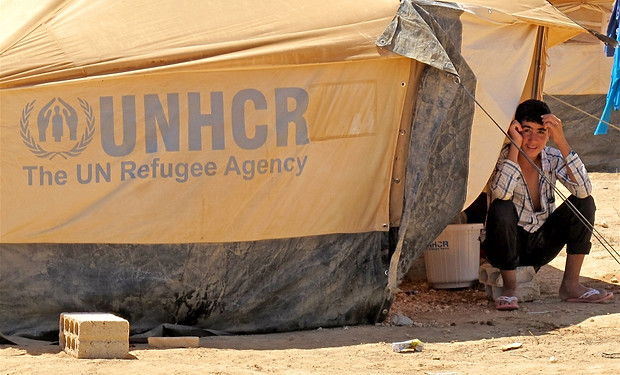
Due to the continuation and escalation of the violence over the past three years, the humanitarian situation in Syria has deteriorated. The United Nations estimates that there are 2,755,777 registered Syrian refugees worldwide, the majority of these located in the neighbouring countries of Lebanon, Turkey and Jordan. There are a further 4.25 million internally displaced people within Syria.
Phillip Deng is a CANADEM registrant who working as a Regional Health Sector Report Writer with WHO in Jordan. He deployed under WHO’s Emergency Support Team monitoring the regional health situation to assist the WHO Country Offices in Syria and in neighbouring countries to develop country-specific health situation reports. Read Phillip’s story regarding his interview with Mr. Mahmoud Othman, a Damascus resident who found refuge in Amman when security concerns in Syria forced him out of his country.
Interview with a Syrian Refugee by Phillip Deng
As Consultant with the World Health Organization (WHO), I saw first-hand how humanitarian aid providers and host communities are working hard to assist Syrian refugees with accessing and benefitting from health services and the support they desperately require. Despite their generous support, however, some Syrian refugees like those with chronic health conditions face challenge. Their experiences and stories can be heart-touching indeed.
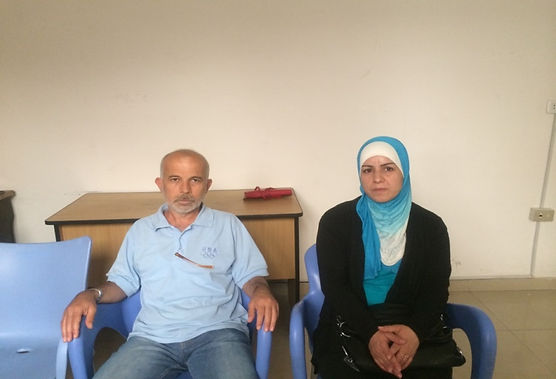
On August 13, 2014, I carried out an interview with a Syrian refugee residing in Amman, Mr. Mahmoud Othman, who is happy to share his story with everyone out there. For someone who works closely with refugees and interacts and speaks with them regularly, as I do, it can be hard to find the right words to describe the feelings that you have when hearing them tell their own stories. Reflecting on the interview we just had with Mahmoud on our drive back, my WHO colleague Mary Sweidan succinctly captured this human dimension and impact: “They are refugees, they were forced to leave their homes and property, they don’t have salaries, they are not allowed to work.”
Mahmoud’s wife died just before the war, leaving him alone with his children. Despite this tragedy he was able to carry on with the responsibility of taking care of his children. Mahmoud had had mild kidney issues at a young age but, amid the violence and disturbances of the on-going conflict, these issues developed into a serious problem. To his shock, he was diagnosed with kidney failure in February 2013, a problem involving both of his kidneys. This complicated life for Mahmoud. He was then put under a kidney failure treatment program, which included weekly dialysis sessions and treatment for hypertension. He didn’t have to pay for the costs of his treatment as all the treatments were given free-of-charge at a government hospital. “Back in Syria all the costs of my treatment, including dialysis, hypertension medicines, vitamin supplements and other costs were covered by the government”, said Mahmoud.
The war situation was not getting any better and Mahmoud saw more people, including his relatives, friends and neighbors leave Syria. He, however, initially thought to wait a bit in Syria in order to be able to continue with his treatment. The conflict was still not showing any signs of coming to end. It was becoming particularly unsafe for children going to school, so he decided to send his children to Jordan to stay with his relatives while remaining in Syria in order to follow up with his treatment. This was about a year ago, in August 2013. He was able to send his children to Jordan thanks to his mother-in-law who helped bring the children.
As the conflict continued to cause more destruction, violence and insecurity, Mahmoud decided it was time for him to leave for his own safety. He finally came to Jordan in March this year. “It was only getting worse; many more people were leaving Syria for their own safety. It became too dangerous and so I decided to leave to join my children in Jordan”, said Mahmoud. But his mother-in-law who is taking care of his children is a widow and her only source of income comes from her late husband retirement pension disbursements. She can barely afford to take care of Mahmoud’s children with this little income. Fortunately, Mahmoud has a niece in Amman, Zakia Al-Sedo, who is married to a Jordanian man and has been living in Jordan for 16 years. She welcomes Mahmoud and his children to stay with her family in Amman, an assistance he badly needed especially in the first few weeks of his arrival. “He is my uncle, the older brother of my mom. I have my own family to take care of but he obviously needs help. I help him with going to the hospital for his kidney dialysis. He needs 3 dialysis sessions per week, so I go with him to the hospital and accompany him to his doctor appointments”, said Zakia who helped bring Mahmoud for the interview and who asked to attend the interview. Mahmoud’s immediate concern upon arrival in Jordan was to find help to continue with treatment for his kidney problem. But this wasn’t easy because of the high costs of treatment for kidney failure in Jordan.
The majority (approximately 85%) of Syrian refugees in Jordan live within the Jordanian community in Amman and other cities, while the remaining 15% are hosted in camps. For the most part, health care services are provided free of charge for camp refugees thanks to humanitarian organizations that provide assistance to these refugees. But not all health care services are free of charge for non-camp refugees, particularly those with chronic conditions like kidney failure, cancer, cardiovascular disease, diabetes, and hypertension. So, as he could not afford the high costs for treatment for his kidney condition, Mahmoud went through hard times during his first few weeks of stay in Amman. Without treatment, his health took a down turn and he became very sick. Fortunately, his health took a dramatic turn for the better after finding the support he needed thanks to a WHO funded-project implemented by a local Jordanian non-governmental organization called Jordanian Health Aid Society (JHAS). Mahmoud came to know about the JHAS project through friends. “He was very ill and in a difficult situation before registering and becoming a client with JHAS. He looks a bit better now as you can see after getting treatment through this project funded by WHO”, said Zakia.
Mahmoud’s story is an example of so many Syrian refugees with chronic conditions such as kidney failure, cardiovascular disease, cancer, diabetes and hypertension who cannot afford the high costs of treatment in neighboring countries. There are reports of some of these patients deciding to go back to Syria for the free-of-charge treatment that is available there, risking their safety and lives in the process. WHO and other humanitarian organizations are working hard and trying their best to help these patients and to support host countries and humanitarian health care partners like JHAS to provide medical care they need so that they do not have to go to back to unsafe situation in Syria that forced them to become refugees in the first place.
Mahmoud and Zakia said they learned the JAHS project is funded by the Canadian government through WHO. “I am very thankful for WHO and the Canadian government for this project, and I hope that this support doesn’t stop because my condition requires long term treatments”, said Mahmoud. The WHO funding covers costs of dialysis sessions, which take place at Aakila hospital, a private specialty hospital in Jabel Amman suburb of Amman.
Mahmoud hopes to go back to Syria if the Syrian conflict stops. “My children and I will of course like to go back to Syria when it is all over, if it is ever going to be over”. It is our country. We lived there for hundreds of years and we hope to go back to rebuild our lives if the war stops”, said Mahmoud.
_______
About JHAS
JHAS is a non-profit and non-governmental local Jordanian organization. JHAS aims to provide high quality health care services to disadvantaged individuals along with spreading health awareness toward life style and disease prevention. JHAS has partnership agreements with several United Nations agencies, including WHO, the United Nations High Commissioner for Refugees (UNHCR) and the United Nations Population Fund (UNFPA) to provide health services for refugees. The WHO-JHAS project aims to provide tertiary health care services to people in need of life-saving medical interventions and patients with chronic conditions like kidney failure and has been running for 3 years now. “I wish I can keep this tertiary care project running for the rest of my life”, said Mary Sweidan, WHO Jordan focal point on the WHO-JHAS project.
About my work with WHO
I was deployed by CANADEM in April 2014 to assist with the Syrian refuge crisis in Jordan under the RAP-Fund Syria project, funded by the Department of Foreign Affairs, Trade and Development (DFATD) of the Canadian Government. I work as part of WHO’s Emergency Support team (EMST) based in Amman, Jordan. WHO is the UN agency mandated to coordinate health matters and to support countries to provide and expand equitable health services to people needing health care, including in emergencies. EMST is WHO’s emergency arm and works to provide support to WHO activities, services and programmes in Syria and neighboring countries affected by the Syrian crisis, including Jordan, Lebanon, Iraq, Egypt and Turkey. WHO also works closely with humanitarian health care providers to ensure adequate response to health needs of Syrians and their host communities. As part of EMST I am closely involved one way or the other with WHO projects and services benefiting Syrian refugees and aware of the challenges patients like Mahmoud are dealing with. Continuation of WHO role and support to humanitarian partners like JHAS is vital if Syrian refugees and patients with special conditions like Mahmoud are to continue to have a chance and hope for access to health care they definitely need.
Special thanks
Special thanks for this interview go to Chris Maher, WHO Polio Eradication and Emergency Support Manager, and Nada Al Ward, Emergency Support Coordinator, for permission for this interview, Mary Sweidan, WHO Jordan focal point for the WHO-JHAS project, for coordinating with JHAS and JAHS staff for arranging the interview at their offices.