CANADEM

UNICEF-Croatia

Since 2015, the European refugee crisis has impacted hundred of thousands of migrants, refugees and asylum seekers. The difficulties of crossing borders and travelling across seas are intensified for children, particularly those who are unaccompanied or separated from their families.

Elaine Bainard, a CANADEM associate, was deployed to Slavonski Brod, Croatia with UNICEF as a Child Protection in Emergencies Specialist from March to June 2016.

Please find below a story from Elaine regarding her time in Croatia.

*All names have been changed.


After a decade of international aid work, I have seen human desperation caused by earthquakes, typhoons, epidemics and war, and have seen some of the best, and the worst and the mediocre that the world had to offer in response. But just when I least expected it, I see a little child trying to crawl under a fence and this global news story of hundreds of thousands of people trying to get to Germany takes on a new meaning. The reality facing desperate people on the move becomes more vivid.

In the mass movement of people out of war torn Syria, Afghanistan and Iraq, escaping from year after endless year of bombings, fighting, insecurity with no end in sight, the country of Croatia has assisted over 659,000 people, with 40 percent of them children, as they moved through the Balkans trying to reach the promised land of Western Europe. When winter came, Croatia did a humane thing and put the people on buses and trains and moved them free of charge across the country, with a quick stop over in Slavonski Brod to get essential humanitarian assistance. But in March of 2016, the borders started to close along the route as countries became overwhelmed with the flood of humanity. Croatia closed her borders as well, stranding people inside the country. Agencies, including UNICEF, had been involved early, trying to help children get warm clothing, nutritious food, diapers, medical care, and a safe space to rest and play. Four babies were born here. While they were moving rapidly through the country, there was little chance of learning their stories, but once these people were stranded, there was plenty of time at the Slavonski Brod camp to get to know them.

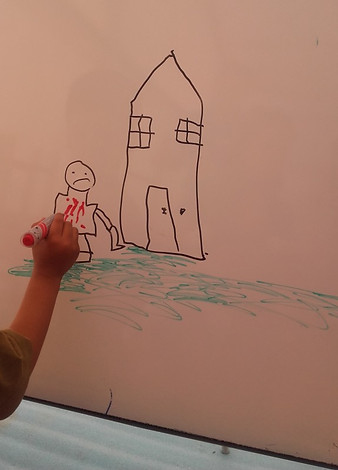
Abdullah is a single father to 5 year old Yusep from Iraq. His wife died a few years ago and it’s just him and Yusep left, and he wants a safer, better future for his son. Yusep doesn’t have the words to express himself, but every drawing he makes depicts people he knew full of bullet holes and bleeding. Despite carrying around these horrible images, Yusep is a sweet boy who came to every single session of the Child Friendly Spaces (CFS) program that UNICEF supported in the Slavonski Brod camp and there he has relaxed, made friends and started to learn.

One of my jobs was to assist the local staff working in the Child Friendly Space, to make sure the program had a therapeutic schedule of structured games, activities and learning opportunities that would support children to regain normality, express themselves, and learn new life skills to help them in their new environments. Children got exercise, learned English and Croatian, drew pictures, played games and sports, made friends, and perhaps most importantly, had a safe place to go where kind and supportive adults made sure that they had what they needed. The CFS was open every day, mornings and afternoons, and every child was welcomed.

Miriam is travelling alone with her two sons, 2 year old Ishmael and 1 year old Farshad, trying to reach her brother in Germany. She’s from a small village in Syria. She never went to school, is barely out of childhood herself, and she is overwhelmed. In early April, she learned that her village in Syria was bombed, her uncle and her niece are dead, her sister is in critical condition in hospital and her husband is missing. Getting information from Syria is difficult and she’s not sleeping very well in her grief. Ishmael and Farshad are adorable children, constantly on the move and they don’t like her to be out of sight for very long. At that age, `no` in any language doesn’t work very well. The Child Friendly Space program recognized early that this mom and her children needed support, so they were always welcome. Miriam and other mothers would come to the program during the children’s English lessons so that they too could learn. Miriam would leave the boys with the CFS staff so she could clean their little living space, take a shower or just rest, or cry.

Nuri is a 3 year old boy from the ISIS controlled region of Syria. Before being at the Slavonski Brod camp, he had never played outside before and had spent most of his young life inside the house watching TV. His parents explained that it wasn’t safe to go outside. The developmental lags are clearly visible and he doesn’t interact with other children. Or rather, he didn’t before attending the Child Friendly Space program. Here, he initially didn’t seem to have any idea what to do with the toys, but with support and individual attention, eventually he would seek out a ball and engage in endless games of catch with whoever would play with him, or he played with building blocks, creating towers that he could knock over. Slowly, he was willing to interact with other children. Nuri has a long way to go and needs to be in a regular kindergarten program as soon as possible, but his family is trapped here in Croatia. Not wanting to apply for asylum here, wanting to reach relatives in Sweden, their fate is uncertain.

I was walking across the camp in one of its final days of operation, just before people were transferred to better facilities, and out of the corner of my eye, I spotted little Ishmael over at a fence. The ground had eroded in that spot, creating a bit of a gully and a place where a two year old could crawl under the fence. A police officer on the other side of the fence was helplessly trying to tell this two year old not to crawl under the fence. Ishmael was having no part of listening, even if he could understand the language, which he couldn’t. It hit me in a new way at that moment, here we have a child who cannot understand that he and his family are stuck, who in his playful exploration of his world was trying to escape under the fence that was put there to keep him inside. This is so much like the situation for many of the tens of thousands of people trapped along the Balkans route, and in Greece; fenced in, powerless, and wanting out.

Ishmael is just one of thousands of children detained across Europe as governments try to stop the movement of people across their territory, of people who are desperate to escape bombing and war and tyranny and hopeless futures. The police officer, helpless against a two year old, is as helpless to stop the flood of people on the move. He isn’t a bad police officer, he wasn’t unkind to the child. I’m sure he would have been happy to help the child to a better life. Just now, it seems like the world doesn’t know how to make that happen. So we continue to do what we can to help restore some piece of childhood for these children and we wait.

More Inspiring Stories

UNICEF-South Sudan

September 29, 2025
Read a photo journal of CANADEM consultant Jan Gerrit Brouwer was deployed to South Sudan with UNICEF

UNHCR-Jordan

September 29, 2025
Read Phillip's interview with Mr. Mahmoud Othman, a Damascus resident who found refuge in Amman

UNICEF-Croatia

September 29, 2025
Read Elaine's story, a CANADEM consultant deployed to Croatia with UNICEF

WFP-CAR

September 29, 2025
Read the biography of Ernest-Moise Mushekuru, Food Security Cluster Coordinator in Central African Republic

UNFPA-Brazil

September 29, 2025
Read Tatiana Almeida's story, CANADEM's Communication Specialist in Brazil

UNICEF-Ethiopia

September 29, 2025
Read Tabasum Abdul-Rasul's story as a Sub-National WASH Cluster Coordinator in Ethiopia
Respect for the environment
An ever-increasing awareness that caring for the environment is the responsibility of us all, regardless of our area of expertise or profession, has propelled CANADEM to place more focus on our own global footprint as well as that of our sector. During this Period, we have embarked on a challenge to enhance our learning regarding the environment and how we interact with it – including efforts to create a baseline and targets for improving how we deal with our natural environment. We are therefore making a conscious and transparent effort to measure and manage the way we affect the natural world around us, hopefully becoming better caretakers along the way.
Impact Driven
CANADEM has always valued the positive impact we make in the world as a foundation of our work. It is this guiding principle that has led us to form lasting partnerships, in support of other entities, if we feel they can add greater value than we can at CANADEM. Searching for our comparative advantage, while avoiding falling into a simple race to find funding opportunities, is therefore essential to CANADEM. As we see an increasing number of individuals suffering from the consequences of conflict in the world, and prepare for even greater numbers of environmental disasters, the need to prioritise the areas where we can make a real difference and combine our efforts with like-minded entities, is vital to achieving success.
Efficiency
The objective of CANADEM’s leadership has always been to find the most innovative and cost-effective ways to contribute to communities in need, and not to place the growth of numbers and our budgets at the centre of our efforts. As a result, we have adopted a light footprint in terms of our human resources complement and infrastructure, making use of the latest technology, and empowering our small team to be as innovative and flexible in solving problems as our procedures allow. Our structures allow us to scale up and down as required, and for staff to work in different teams, according to the needs of the moment. Our 30 years of experience has taught us what our core capacities are and how to allocate precious resources.
Accountability & Transparency Values
From CANADEM’s earliest beginnings as a Government of Canada project, and during its rapid evolution into an independent NGO with its roots in international service, the principles of accountability and transparency have been a component of CANADEM’s DNA. Accountability for the use of public funds has been incorporated into procedures that needed to respond to the high standards of government. Transparency has been the vehicle to ensure the vital accountability that CANADEM maintains. CANADEM’s headquarters team is a well-trained group of committed individuals who believe in the important work they do – including the conviction that providing the best value possible to the communities and donors we serve is a primary component of our job. CANADEM’s rules and procedures are therefore established to ensure that every step of the way we are confident of our work, and can demonstrate its efficiency and effectiveness.
People-Centered Values
Our work is about deploying people to help people. It is therefore of paramount importance to us that we are all relating to individuals in our chain of service delivery in a way that is respectful, understanding, considerate, and that brings out the best in us. Our internal working context is designed to foster humanity, fairness and support among our staff, which in turn aims to foster those same qualities among the experts we deploy. We have invested in a team of individuals (our Duty of Care Team), who provide a safety net for those experts we deploy. By taking care of our staff members and our deployed experts, we ensure that we have an effective flow of communication between all aspects of our operation. Our experienced and motivated staff feel supported, and are in turn able to support our experts in times of stress and prevent any potential problems from occurring.
Diversity & Inclusion Values
Ensuring an inclusive workplace that integrates diversity in terms of gender, language, culture, ethnicity and religion, is of prime importance for CANADEM both internally and with regards to our work with partners. We have made significant progress in attracting experts from 178 countries around the world – including from countries that are recipients of international assistance – so that a diversity of perspectives, understanding and expertise may be integrated into all operations that CANADEM supports. From our fair and transparent selection process, to our supportive Duty of Care Team (which ensures that individuals deployed have the resources they need to feel comfortable and confident in their work), we have invested significant energy in fostering diversity and inclusion within our roster system, in our election monitoring deployments, and in our own direct implementation of programming, at headquarters and in the field.
Partnership Values
The majority of our experts work within the assistance operations of our partners. Partnership is therefore of primary importance and value to us, and is key to the way we operate. Our many long-term relationships with other actors have been forged by promoting trust and understanding. The ability to work together with other actors, and not in competition, has allowed CANADEM to enhance the work of governments or organizations by injecting vital expertise, and targeting it where it is needed most. We believe that we can create a greater impact, when we work in partnership.